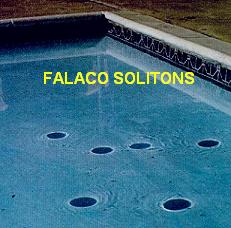
Cartan's Corner  Falaco Solitons - Cosmic Strings in a Swimming Pool
Cartan's methods of exterior differential forms are applied to a variety of physical problems.
Best viewed with 3.0+ browsers, sound turned on, and al least SVGA.

Current Topics in Applied Topology

See warning below about bugs in early versions of Adobe Reader -

Paperback POD and ebooks are now available from Cartan's Corner.


Updated August 11, 2007

The Cosmological Vacuum

This article examines how the physical presence of field energy and particulate matter can be interpreted in terms of the topological properties of space time. The theory is developed in terms of vector and matrix equations of exterior differential forms. The theory starts from the sole postulate that field properties of the Cosmological Vacuum (a continuum) can be defined in terms of a vector space domain, of maximal rank, infinitesimal, neighborhoods, where exact differentials are mapped into exterior differential 1-forms, |A>, by a Basis Frame of C2 functions, [B], with non-zero determinant. The particle properties of the Cosmological Vacuum are defined in terms of topological defects (or compliments) of the field vector space, where the non-zero determinant condition fails. When the exterior differential 1-forms, |A>, are not uniquely integrable, the fibers can be twisted, leading to possible Chiral matrix arrays of certain 3-forms of Topological Torsion and Topological Spin. In addition, there exist Chiral objects constructed from vector arrays of 1-forms that mimic the properties of the Einstein tensor. The abreviated theory is backed up by a detailed example in Maple format for the isotropic Schwarzschild metric.


Updated August 11, 2007

Is the Chiral Universe Rotating?

In electromagnetic systems, chirality can be related to constitutive properties that link D to B and H to E. Optical activity is associated with the imaginary part of a chirality linkage, and Fresnel-Fizeau phenomena can be related to the real part. A combination of Fresnel-Fizeau rotation and Optical Activity can break the inbound-outbound symmetry of propagating electromagnetic singularities, an effect that can be measured in dual-polarized ring lasers. As the chirality concept is related to centers of symmetry, or fixed points of expansion and rotation, and as the universe appears to be expanding, it is natural to ask: Is the universe rotating, as well as expanding?


Updated June 3, 2007

A Thermodynamic Explanation of why electrons in a Bohr orbit do not radiate.

The 1-form of Action that encodes the thermodynamic properties of an orbiting electron consists of two components. One component represents the acceleration of contraction to a fixed point -- the inverse r squared law. The second component represenents the acceleration due to a rotation about the fixed point. It is easy to show that the Pfaff Topological DImension of the 1-form is in general 3 for the specified Action 1-form of two components. Hence the non-equilibrium thermodynamic system is closed, and will exchange radiation to its environment. However, if the second term representing the rotation is homogeneous of degree zero, it then corresponds to deRham period integral, which when integrated around a closed cycle has values with integer ratios. The Pfaff topological dimension of the thermodynamic 1-form becomes equal to 2, and the resulting thermodynamic system is an isolated equilibrium system that does not exchange matter or radiation with its environment. The "quantized" orbiting electron does not radiate even thought it is accelerated.


Updated June 3, 2007

Turbulence and the Navier Stokes Equations

The concept of Continuous Topological Evolution, based upon Cartan’s methods of exterior differential systems, is used to develop a topological theory of non-equilibrium thermodynamics, within which there exist processes that exhibit continuous topological change and thermodynamic irreversibility. The technique furnishes a universal, topological foundation for the partial differential equations of hydrodynamics and electrodynamics; the topological technique does not depend upon a metric, connection or a variational principle. Certain topological classes of solutions to the Navier-Stokes equations are shown to be equivalent to thermodynamically irreversible processes. The method demonstrates, by example, how an irreversible dissipative process acting in an Open non-equilibrium system of Pfaff topological dimension 4 can decay, or create in finite time, topological defect structures, or Closed systems of Pfaff topological dimension 3. These Closed non-equilibrium systems admit a Hamiltonian process which can emulate the geometrical evolution of topological stationary states far from equilibrium. The theory of Continuous Topological Evolution gives formal credence, as well as analytic examples, to the Prigogine conjecture of self-organization in terms of disspative (thermo)dynamics (written in response to the Clay Institute millenium challenge).


Updated June 3, 2007

Prigogine'a Thermodynamic Emergence and Continuous Topological Evolution

Irreversible processes can be described in Open non-equilibriumthermodynamic systems, of topological dimension 4. By means of Continuous Topological evolution, such processes can cause local decay to Closed non-equilibrium thermodynamic states, of topological dimension 3. These topologically coherent, perhaps deformable, regions or states of one or more components appear to "emerge" as compact 3D Contact submanifolds that can be defined as topological defects in the 4D Symplectic manifold. These emergent states are still far from equilibrium, as their topological (not geometrical) dimension is greater than 2. The 3D Contact submanifold admits evolutionary processes with a unique extremal Hamiltonian vector component, as well as fluctuation spinor components. If the subsequent evolution is dominated by the Hamiltonian component, the emergent topological defects will maintain a relatively long-lived, topologically coherent, approximately non-dissipative structure. These topologically coherent, "stationary states" far from equilibrium ultimately will decay, but only after a substantial "lifetime". Analytic solutions and examples of these processes of Continuous Topological Evolution give credence, and a deeper understanding, to the general theory of self-organized states far from equilibrium, as conjectured by I. Prigogine. Moreover, in an applied sense, universal engineering design criteria can be developed to minimize irreversible dissipation and to improve system efficiency in general non-equilibrium situations. As the methods are based on universal topological, not geometrical, ideas, the general thermodynamic results apply to all synergetic topological systems. It may come as a surprise, but ecological applications of thermodynamics need not be limited to the design of specific hardware devices, but apply to all synergetic systems, be they mechanical, biological, economical or political. (submitted for consideration of the WTI Prigogine award)


Updated April 18, 2007

The powerpoint presentations of a talk, "Non-linear, Topologically Coherent, and Compact Flows Far from Equilibrium" given at the EGU 2007 conference are made available for those interested.

The fundamental idea is that topological thermodynamics predicts the production of topological defect structures
of Pfaff Topological dimension 3, "condensing, or emerging" from a turbulent domain of Pfaff Topological Dimension 4,
by means of thermodynamically IRREVERSIBLE, dissipative processes.

The Pfaff Topological dimension 3 subdomains are thermodynamic systems that are far from equilibrium,
but admit Hamiltonian evolutionary processes that describe "stationary" states, which have relatively long lifetimes.

Vienna EGU April 20, 2007 "Part1"
Vienna EGU April 20, 2007 "Part2"
Vienna EGU April 20, 2007 "Part3"
Vienna EGU April 20, 2007 "Part4"

_________________________________
Get the free Adobe 5.0 pdf file reader
WARNNG: Adobe Reader 5.0 has symbol problems that are not in Adobe Reader 4.0 and 3.0. PDF files created with older versions of Adobe Acrobat do not necessarily display properly when using Adobe Reader 5.0 (they do display properly using Adobe Reader 4.0). The pdf files on Cartan's corner are gradually being recompiled to work with all versions of the Adobe reader. Please advise me by email of those pdf files that display improperly

Topological Torsion Picture Catalogue.

Key Resource
Links2Go award for
(Differential) Geometry

animated email gif


Copyright © 1995-2007, CSDC Inc. All rights reserved.
Last update 03/19/2008

top